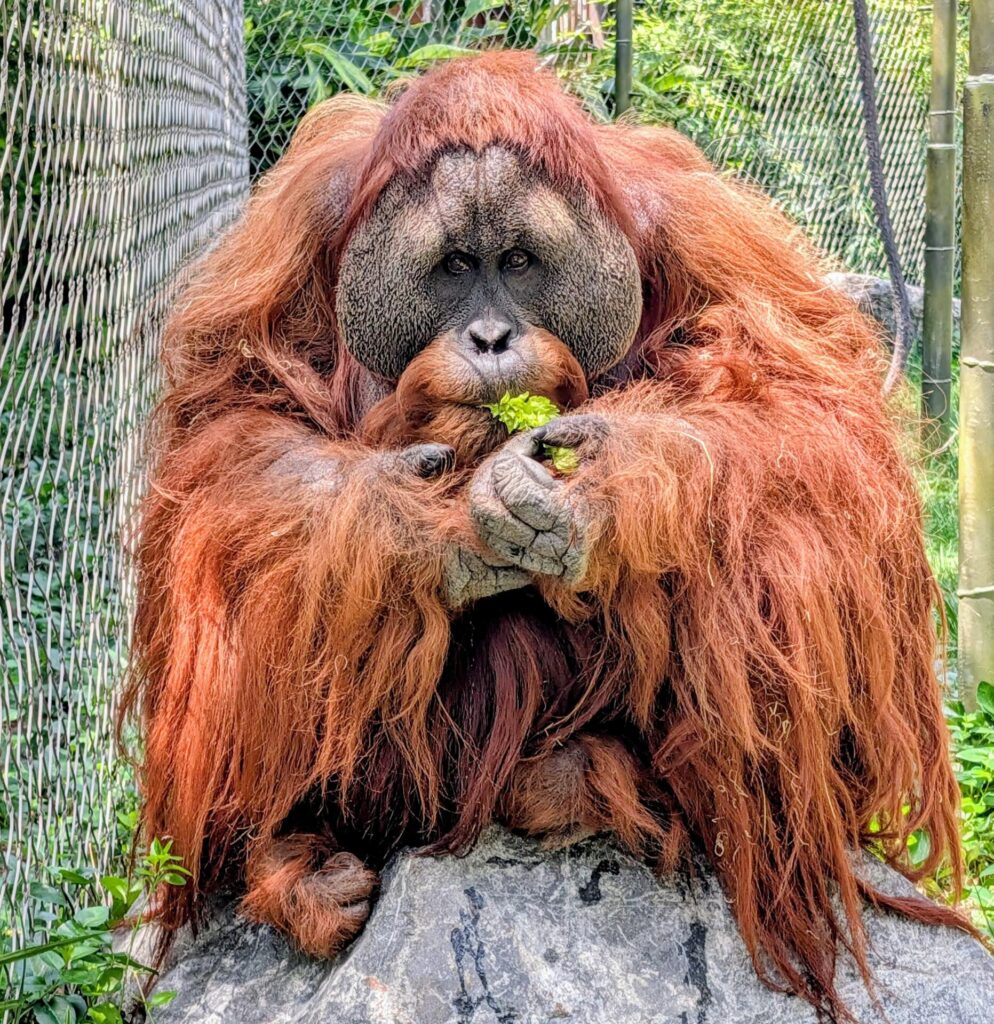
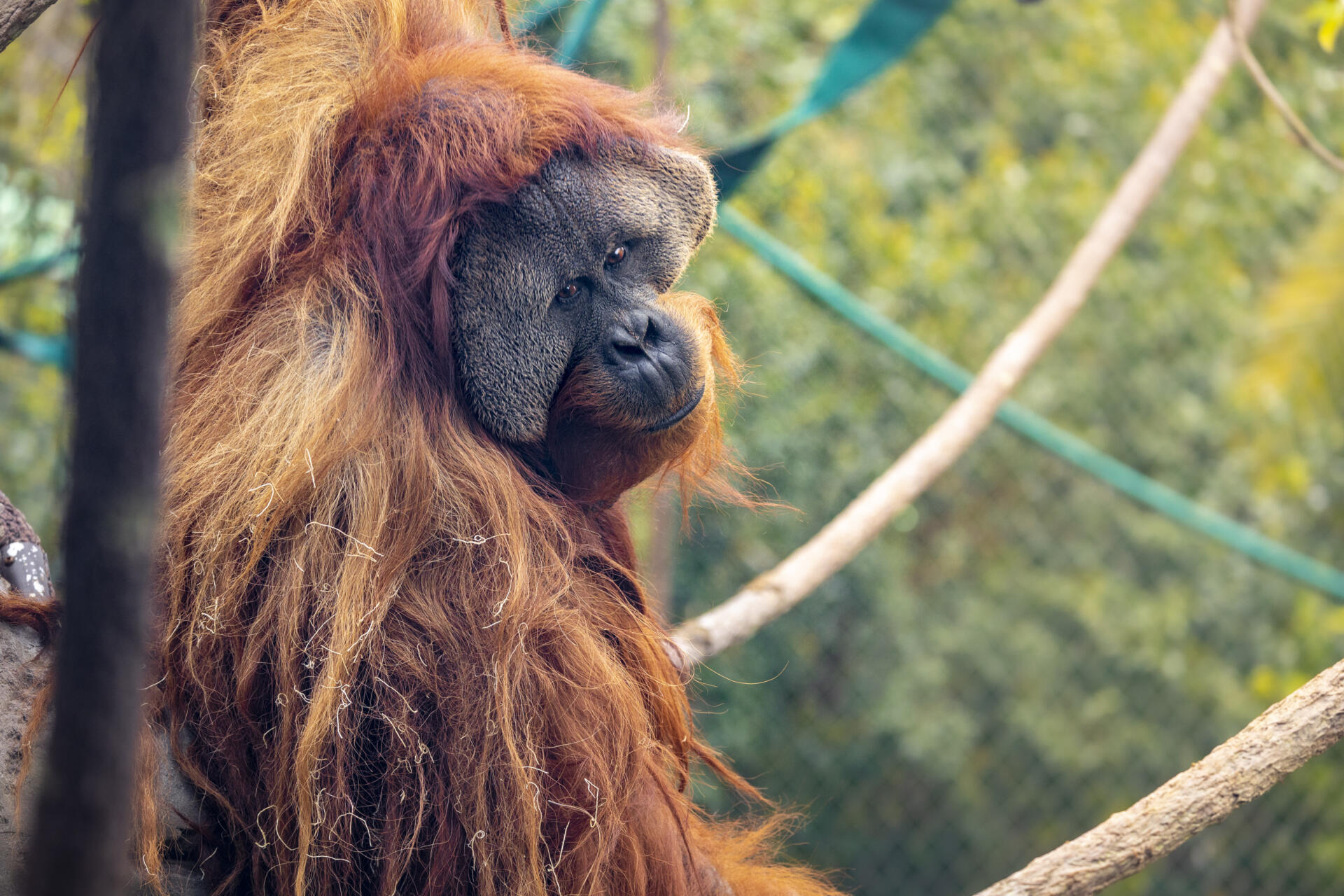
Meet Busar, the 42-year-old male of the Buffoonery, a group of Orangutans, at Fresno Chaffee Zoo.
Busar was born in 1984 at the Yerkes National Primate Research Center at Emery University in Atlanta, Georgia and was transferred to Fresno Chaffee Zoo in 1997 at the age of 13. Here in Fresno, Busar has fathered four children: Labu and N’dari in 2010, Hantu in 2018, and Marigold in 2026. He currently resides in his habitat in the Zoo’s Kingdoms of Asia exhibit.
So, what does a day in the life of Busar look like? The Zoological Care Specialists on Busar’s team arrive in the early hours of the morning and typically say good morning to the orangutans first. Busar makes excellent, thick nests on the ground every night and will often stay in bed until you bring him a treat. We give him his morning vitamins, probiotics, and any medicine he might be prescribed inside a spoonful of yogurt, and that usually does the trick to get him up and moving around for breakfast.
Our team works carefully to manage the five orangutans in our care and ensure they are all getting properly trained by working with each individual animal every morning. All of the orangutans in our care know many voluntary medical behaviors that help us maintain their health. Volunteering their arms for a blood draw, opening their mouths for us to brush their teeth, presenting their stomachs for ultrasounds, providing urine samples, and standing on scales that can serve as X-ray stations are all advanced behaviors learned throughout training sessions over time. Busar may even receive practice injections, simulating how we would do a real medical procedure and give vaccines if needed. As the morning progress and training finishes, our team will then begin to plan which apes will be out on habitat for the day, what enrichment items we should put out for them, what tasks we need to complete as a team, and which of us is about to spend a lot of time with Busar.
About 20% of orangutans in human care develop a condition called ORDS: Orangutan Respiratory Disease Syndrome. It is believed that this species-specific condition is similar to Cystic fibrosis, a chronic disease in humans, and can cause infections in the lungs, sinuses, and air sacs ranging from mild to severe cases. ORDS can be unpredictable. The severity of it in each body differs, and which symptoms present more intensely is unique to each individual, so it is something that all accredited zoos take very seriously.
Over the years, Busar started to show signs of ORDS, like flair-ups of chronic allergy-like symptoms that began to worsen with age, but getting a confirmed diagnosis would mean transporting Busar to another facility to get an MRI at a specific machine. The MRI had to be large enough for an adult male orangutan, had to allow a non-human primate access, and had to be in a facility close enough for Busar to be safely transported there and back. In this case, unfortunately, the Zoo could not find an MRI machine that met all of the criteria we needed. So, without this diagnosis, we can only treat the symptoms of ORDS.
Busar has been on several oral and nasal spray type medications over the years, but his treatment plan has continued to evolve as other institutions and researchers have continued to learn about this disease. In early 2023, Busar began a new type of treatment that required him to inhale a regimen of medications through a nebulizer. This method of treatment was not new in the zoological care field, but it was new to Busar. Every individual’s treatments are going to be a little different and require many hours of precise training. This is where our team’s dedication to training with these animals every day comes in handy.
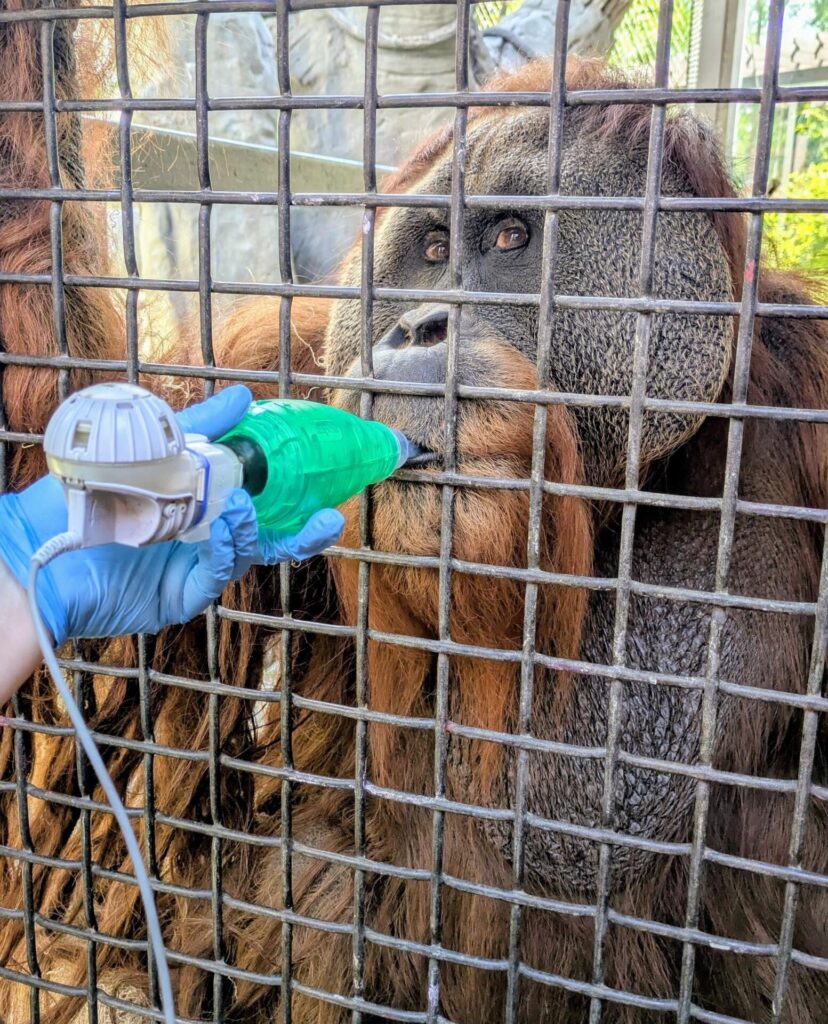
Using positive reinforcement, we were able to not only train him to breathe in and out through a flutter valve, but further, to sit and participate with the trainer for an extended period of time. A typical session these days takes nearly an hour, and this happens twice a day! That’s over an hour of Busar sitting face-to-face with a Zoological Care Specialist, breathing in and out through the machine, and getting small food rewards after every short set of breaths until the prescribed series of medications have been completed.
This very important treatment can become repetitive and boring for both Busar and the Zoological Care Specialist with him. Just like humans, Busar can have days where he is happy to participate, and others where he might be a bit grumpy, but very rarely does he choose to not participate at all. The whole routine takes a lot of patience from both parties, so we break up the sessions with other trained behaviors, physical exercises, games, and food rewards. He has also listened to his fair share of audiobooks and podcasts over the years, because sometimes humans need enrichment too.
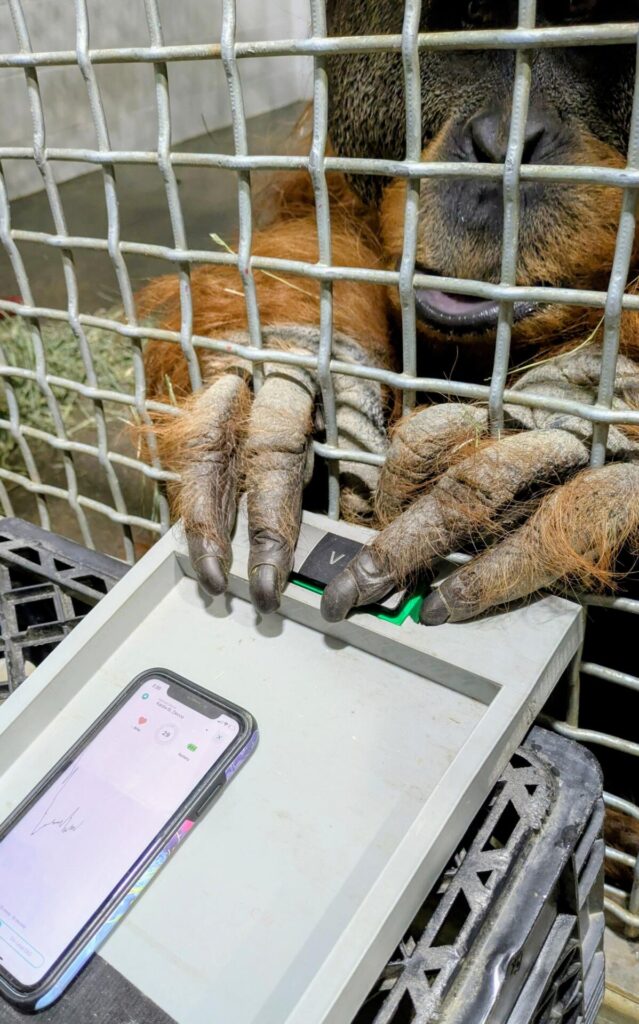
Another health concern in apes is their cardiac health, with cardiovascular disease cited as the cause of death for 20% of orangutans in human care. During a recent routine check-up, our veterinary team brought in a special Echocardiographer to check on Busar’s heart. He is trained to participate in voluntary echocardiograms by pressing his fingers down on the sensors of a KardiaMobile device. Then, we can download an EKG to our mobile devices and send them directly to our veterinary staff. This can be a little tricky because orangutans tend to use their fingernails to press things instead of their fleshy fingertips, but Busar remains patient until we are able to get the scan.
The data gathered during his exam will not only be critical in tracking his cardiac health over time, but was also submitted to the Great Ape Heart Project, based out of the Detroit Zoo, to help strengthen the knowledge of cardiovascular disease in his species.
While Busar does have a bit more specialized care than the other orangutans at Fresno Chaffee Zoo, he is in good health for his species and age. His willingness to participate in his own health care keeps his concerns manageable. Thanks to the hard work of his veterinary and care staff, Fresno Chaffee Zoo has been able to improve his quality of life and help Busar remain the orangutan that we know and love.