

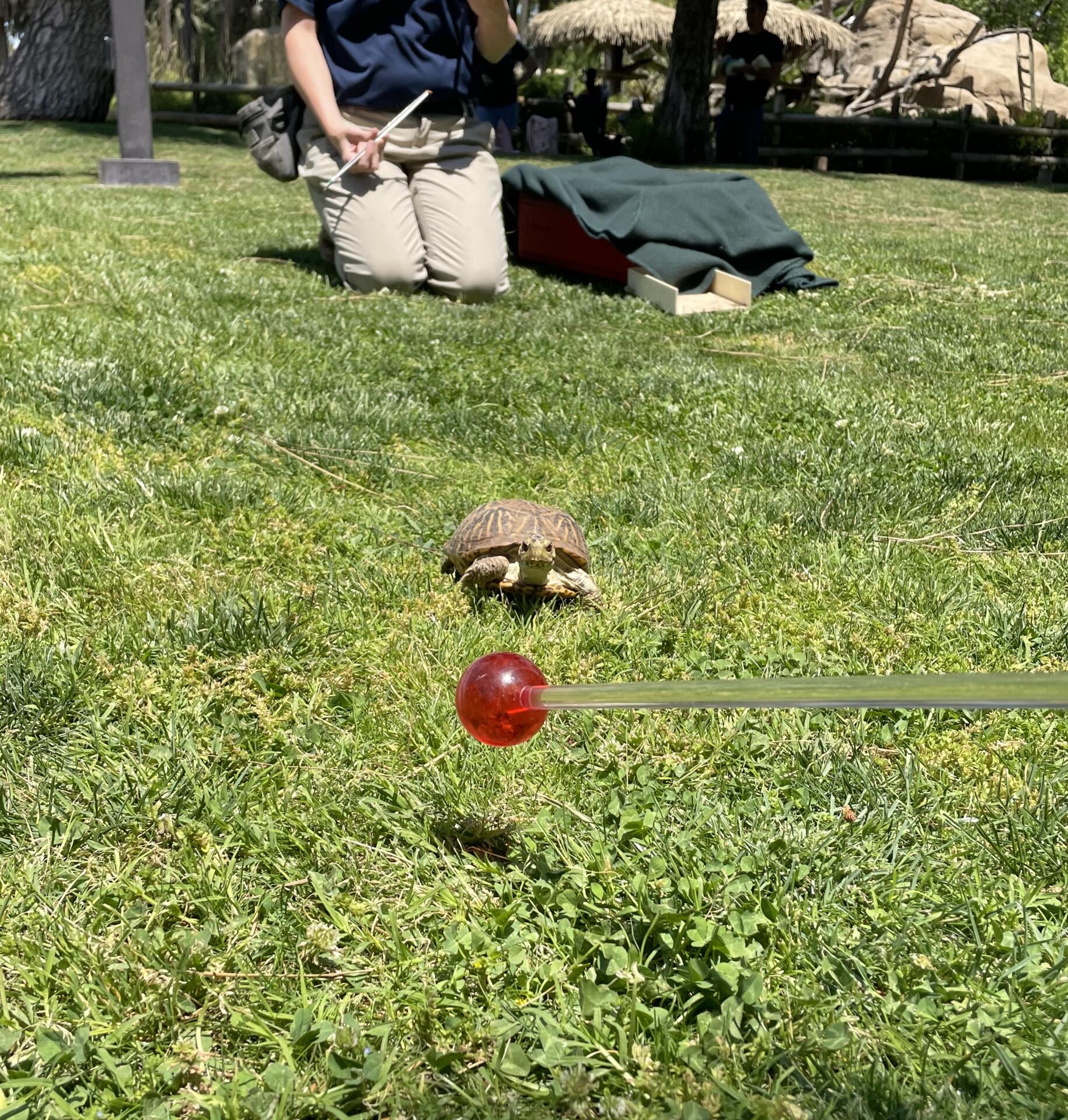
Did you know that reptiles are trainable? Guests at Fresno Chaffee Zoo are often surprised that in addition to training mammals and birds, we also train many of our reptiles.
In the Animal Ambassador program at Fresno Chaffee Zoo the reptiles live behind-the-scenes, but help educate guests by appearing at on-site programs and traveling to schools, senior centers, the local news, and more. These reptiles are almost all trained to follow a red ball on a stick, a behavior called targeting. This allows us to give them a choice about whether they want to participate in these programs. They can follow the target stick to go out on a program and get some treats, or they can stay in their home and get their treats later.
How do we train our reptiles? The first step often involves some taste testing. We set this up so that we can determine what an individual’s favorite treat is. Once we know an individual’s favorite treat, we will offer this treat right next to the target stick to make sure they are not afraid of the target and that they associate it with snack time. Then we will start to move the treat behind the target, so that they touch the target before they get the snack, eventually removing the food from sight but giving it once they touch the target stick. Once our reptiles understand the behavior, many of them become so excited to target we can take them on walks in areas around the Zoo, allowing them to get more exercise and showing everyone how fast a turtle or lizard can move across an area.
We have also trained our reptiles in color differentiation. When Zena, our ornate box turtle, sees a blue or a green target, she will ignore these colors and only hit the red target because that is the only color that gets her a mealworm. This shows how box turtles can see distinct colors, a fact that sometimes surprises guests. You can enjoy the video of her demonstrating this ability.
Patience and small steps are important when training reptiles as they may not be as quick to respond as mammals and birds. It is also important to know about an animal’s natural abilities and tendencies. For instance, with our leopard geckos, we must move the target stick back and forth slightly when targeting because their eyes see movement better than they see color. Some animals also see certain colors better than others. The animal care team working with Besar, the Sunda gharial that resides in Kingdoms of Asia, switched to a pink target because recent research shows that many crocodilians are more attracted to that color. After switching the target color, the animal care team noticed an improvement in their targeting sessions with Besar.
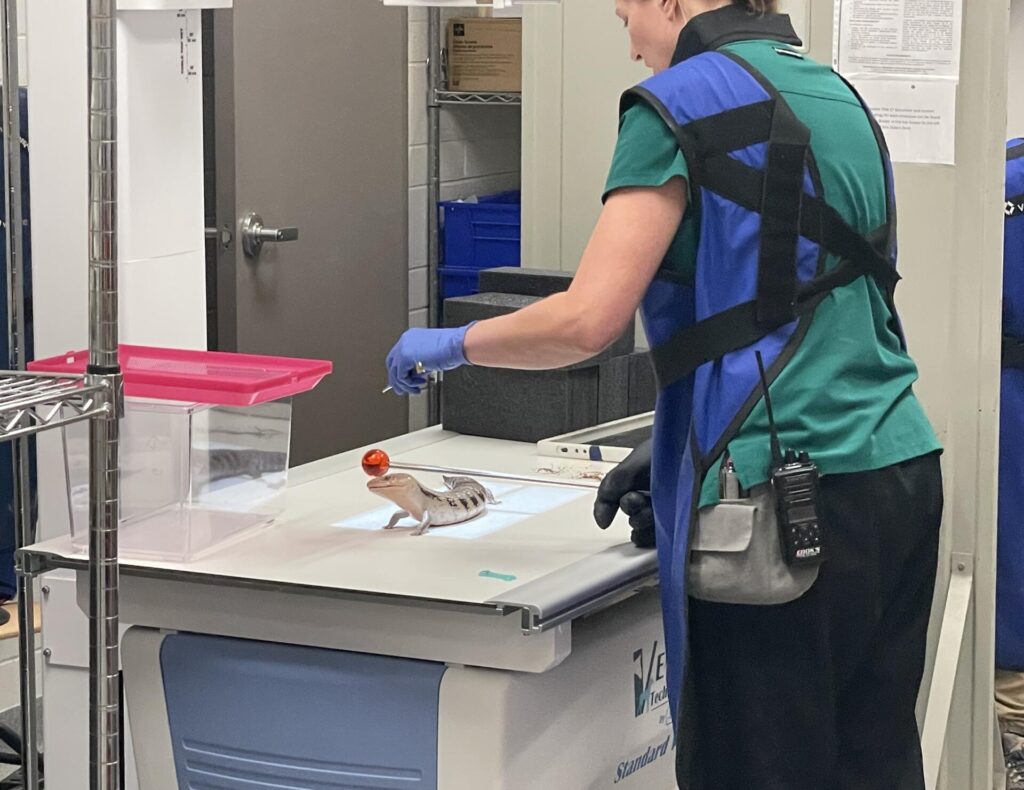
Another wonderful benefit of targeting is to help our animals with medical procedures. Part of our animals’ yearly health checks are radiographs. We recently used targeting with Randall, our blue-tongued skink, to take radiographs without sedation or physically holding him in place, as you can see in the picture. This is valuable because every sedation can have risk factors, and restraint can be stressful for animals. Training can reduce risk and make veterinary visits enjoyable for the animals.
Several of our reptiles are also learning to ring a bell and other new behaviors with the help of targeting. This target behavior is something we train many of the animals living at Fresno Chaffee Zoo to take part in, and it helps them all live healthier lives with us.